
Jones County 72 Hour Releases
No verified Jones County, Georgia three-day release feed was found. Do not confuse this county with similarly named sheriff sites in other states. The local sheriff's JavaScript app provides current inmate search access, not a proven rolling release archive.
Important: Build the three-day result from official records instead of assuming that disappearance from the roster proves release.
Rebuild Jones County Three Day Releases
Set two exact timestamps before searching.
- Check the current sheriff search.
- Review VINE custody changes.
- Check Magistrate and Superior Court events.
- Search GDC for a possible state transfer.
- Ask the sheriff for existing releases between the timestamps.
Use Released Last 24 Hours when the event likely happened today.
Jones County Three Day Fields
A useful existing record may contain the following fields, though the agency can redact exempt material.
| Field | Question answered |
|---|---|
| Release date and time | Was it inside the window? |
| Release type | What authority ended local custody? |
| Charges and bond | Was the case still pending? |
| Receiving agency | Was this a transfer? |
| Booking number | Which custody episode? |
Jones County Weekend Release Checks
The public sources do not state special weekend, holiday, or processing rules. A 72-hour range is still useful because it spans more than one business day and reduces errors caused by uncertain timing. Use the actual recorded release timestamp, not an estimate based on when the roster changed.
Request Jones County Three Day Records
Submit a narrow request through the sheriff records page. Ask for releases between the exact start and end times and list the fields needed. The agency may say no compiled report exists, apply lawful redactions, or charge permitted costs.
For a named person, the Jones County released-inmate lookup is more precise. VINE can support the time of a custody change, while court records explain bond or disposition and GDC identifies state custody.
Jones Sheriff App Data Window
The official sheriff app's Inmate Info route may require a rendered browser or mobile app. Accessible source material did not confirm a 72-hour filter, update cadence, or retention period. Those facts must not be inferred.
Verify Jones County Three-Day Releases
A three-day check works best as a dated records exercise, not a scan of the live roster. Begin with the Jones County Sheriff inmate search. A matching current entry means the person still appears in local custody. No match is only a clue. The person may have been released, transferred to GDC, moved under a hold, or entered another agency's custody. Record the exact time of the check because the three-day window keeps moving.
Next, use Georgia VINE for a named-person custody status check. Then compare the Superior or Magistrate Court record with the sheriff record. A court order, bond action, or disposition can explain the legal event, while the jail release record supplies the operational release date and time. For a person sentenced to state prison, use the GDC offender search because leaving the county jail can mean transfer rather than community release.
- Search the full name in the sheriff's current inmate route.
- Check Georgia VINE and note the listed agency and status.
- Review the relevant Jones County court docket for a bond or disposition event.
- Check GDC when a state sentence or transfer is possible.
- Request the sheriff's booking and release record for final confirmation.
Request Jones County Release Records
The Sheriff's open-records route is the direct fallback when no public three-day feed exists. Give the person's full name, an approximate booking date, and the exact 72-hour interval. Ask for the booking number, booking date and time, release date and time, release type, releasing authority, charges, bond status, and any releasable hold or transfer notation. Narrow dates help the records clerk identify the correct event and estimate any cost.
The county also publishes an open-records request page with a request form and resolution. Under Georgia's Open Records Act, public records are available for inspection and copying unless an exemption applies. O.C.G.A. 50-18-71 uses a three-business-day response framework when records cannot be produced at once. That period concerns the agency response, not a guarantee that a 72-hour release report exists or that every record is immediately ready.
| Requested field | What it resolves |
|---|---|
| Release date and time | Whether the event falls inside the chosen window |
| Release type | Bond, time served, court order, transfer, or another basis |
| Releasing authority | The office or court tied to the release |
| Hold or transfer note | Whether local custody ended but other custody began |
| Booking number | The exact local custody episode |
Jones County Release App Limits
Jones County's sheriff website is an OCV JavaScript application. A plain text visit can return only the app shell, and the sheriff inmate FAQ directs users to the Inmate Info tab in the official mobile app. The Apple listing and Google Play listing describe public-safety news, alerts, tips, and interactive features. Neither source confirms a retained 72-hour release list.
This technical quirk matters. A blank browser-rendered result, an app-only screen, and the absence of a name from current custody do not carry the same meaning. Use the app for the current Jones County Jail check, but rely on the dated sheriff record, VINE status, court event, or GDC record to establish what happened during the prior three days.
Jones County Weekend Release Checks
A 72-hour interval often spans a weekend, which makes court and record timing important. Jones County Magistrate Court lists first appearances on Monday, Wednesday, and Friday after 5 p.m. at the Sheriff's Office. That schedule can help explain why a bond event appears near the edge of a weekend search. It does not establish the actual jail exit time. The release record remains the source for that timestamp.
The Georgia Sheriffs' Association jail report supplies statewide jail-population context, not a Jones County person lookup. Its screenshot illustrates the distinction between aggregate jail data and a named release record.
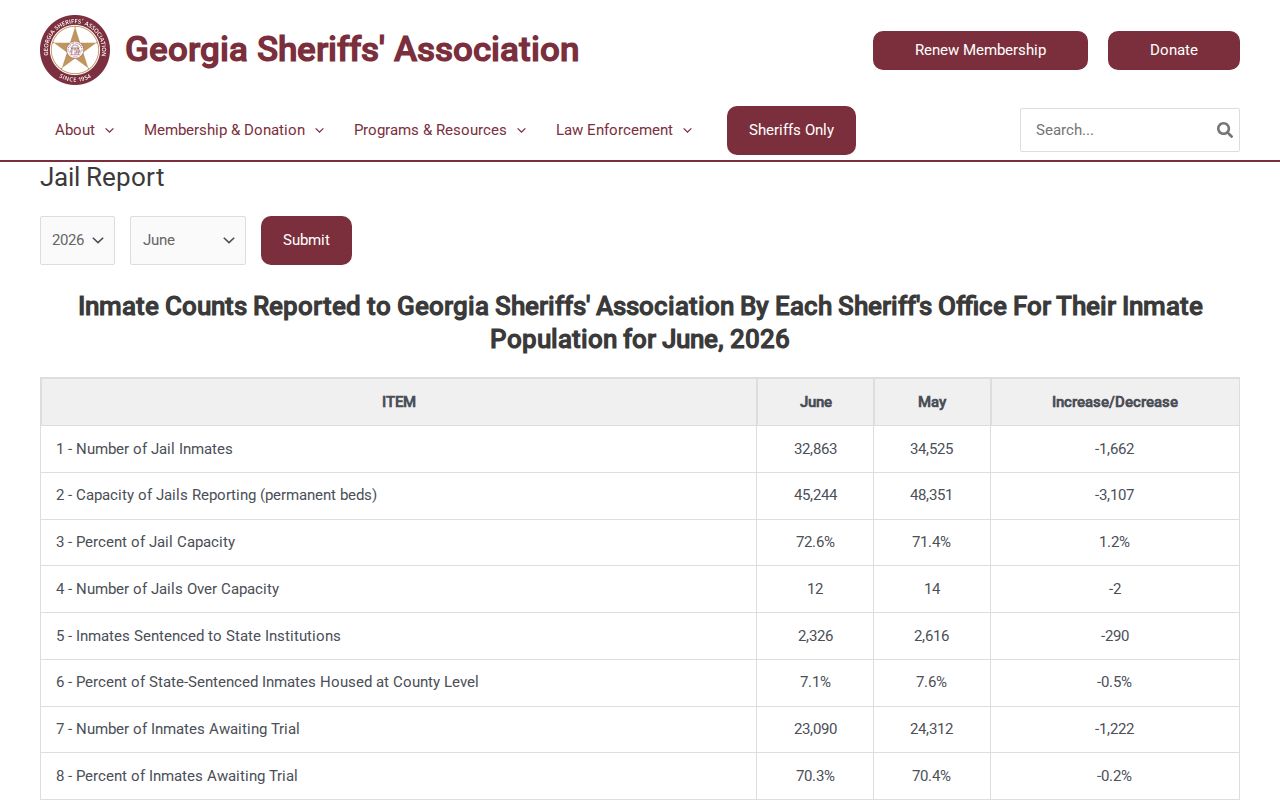
The statewide report cannot confirm who left the Jones County Jail. Pair any broad trend with the sheriff's dated release record for the named person.
Jones County Release Types Compared
The release type determines what to check after the three-day window. Bond ends the jail hold under stated terms while the case continues. Time served means credited confinement satisfied the custody ordered in that matter. A dismissal or no-prosecution event concerns the charge, but the record should still be matched to the exact booking. Transfer ends Jones County custody and begins another authority's custody.
| Release entry | Follow-up source |
|---|---|
| Bond | Magistrate or Superior Court docket |
| Time served | Sentencing order and jail record |
| Transferred to GDC | GDC offender search |
| Other county or federal hold | Receiving agency locator |
| Released with supervision | DCS office or parolee search |
Use the wording the agency supplies. Terms such as discharge, release, and transfer describe different events and should not be collapsed into one status.
Jones Supervision After Release
For a person placed on felony probation, parole, or a split sentence, the Milledgeville DCS Field Office is the local supervision office serving Jones County. The office is a post-release channel, not a jail or a three-day release feed. For parole, the state parolee search may provide a public match. A probation order belongs in the court docket.
If the three-day interval begins or ends near a holiday, request exact timestamps rather than assuming a delay. The public research found no Jones County policy that changes release timing on weekends or holidays. The official record is more reliable than a general expectation about when processing should occur.
Note: Define the three-day interval before searching. A named start and end time makes the records request precise and keeps a late-night release from falling into the wrong calendar-day list.
Identity checks matter across a 72-hour list because repeat names and multiple bookings can overlap. Use a booking number when available. Otherwise compare the full name, arresting agency, booking date, charge court, and age or date fields shown by the official source. Do not merge two custody episodes merely because the names match. A prior release may belong to an older case while the live roster reflects a new booking. The sheriff's records clerk can connect the correct booking and release timestamps. Court records then show whether the related matter remains open, ended, or moved to another stage. Preserve each source date so later updates do not obscure what was displayed during the selected three-day interval.
The Jones County Sheriff records route can also identify the releasing authority and arresting agency, two fields that a simple name list may omit. Ask whether any releasable property note or hold notation belongs to the booking. Those details help explain processing without turning an assumption into fact. When the release follows a first appearance, preserve the Magistrate Court event date and compare it with the later physical exit time.